19+ slightly left-field interventions to restore your circadian rhythm

Updated: 4 days ago
and a traditional checklist if you're in crisis
I’m almost as fed up with the term biohacking as I am self care. But beneath the noise there are researched & proven missing pieces of the jigsaw that can reshape your sleep architecture with little or no effort.
Sleep is now a six hundred billion pound industry, & we're still sleeping roughly an hour less than we did sixty years ago. More devices, more tracking, less rest. As sleep scientist Andy Galpin puts it, the answer is rarely another gadget - the real question is why you're sleeping badly in the first place. The bigger blind spot ? An estimated 70-80% of people with sleep apnoea are never diagnosed, rising to 95% among women - none of that counts insomnia, restless legs, or the sleep disruption that follows having a baby.
Vitamin D was a game changer for me. Renowned neurologist Dr Stasha Gominak talks about how it improves the quality of deep sleep, REM, & transitional stages - and actually a hormone mistakenly classified. It's role is essential to support the brainstem chemistry receptors & production of acetylcholine - without it, the brain effectively forgets how to organise restorative sleep.
protect the night. then meet the morning
An eye mask is a sensible response to a streetlight - directly mitigates the problem. The mistake is replacing it after you check the alarm clock or wander to the bathroom.
At your intended waking time
whip off the eye mask
open the curtains before heading to the bathroom
step outside or stand where actual daylight reaches your eyes
give the brain a clear signal that biological daytime has begun
Morning light suppresses remaining melatonin and resets the master clock. It starts the daytime hormonal and neurological cascade and makes the circadian rhythm more resilient to the light you will inevitably encounter later.
The eye mask is important because it mitigates unwanted light. Removing it is equally important because the body needs contrast between night and morning.
your brain needs less to do
Your brain needs to stop investigating, anticipating and solving. White noise and television may both feel comforting, but they make very different cognitive demands.
Language requires cognitive work. The brain follows meaning, identifies voices, predicts the next sentence and responds to changes in emotion, volume and subject.
You are asking the frontal cortex to remain involved when the goal is to stop giving it work.
white noise softens unpredictable sound
a familiar, neutral soundscape gives an active mind less to investigate
television and podcasts continue presenting information to process
if tv sends you to sleep, exhaustion may simply be overwhelming its cognitive demands
Sleep, Max Richter, from the eight hour album of the same name, composed specifically as an all night listening experience - often rated top of the pops on Spotify.
melatonin: a clock signal, not a knockout drop
what it is
Melatonin is a hormone produced naturally in response to darkness. It helps coordinate the fall in alertness and body temperature that prepares us for sleep.
It doesn’t clear adenosine, nor is it a sedative for anxious thoughts that can force an active brain into unconsciousness. It tells the body that biological night has begun.
it works well when
Melatonin is particularly useful for a short, deliberate circadian reset, especially after crossing time zones.
Taken at the correct local time, it can help persuade the body that night now begins somewhere else. You might feel drowsy within 30 to 45 minutes, sleep at the new local time and put it away again after two or three nights.
That is a specific job with an end point.
it has limits when
Taking melatonin after waking in the middle of the night is different. Your circadian system already knows it is night. Telling it again at 2am does not necessarily address the reason you are awake, particularly when that reason is cognitive arousal.
It may simply extend the hormonal night into the following morning - hello sleep inertia - you’ve created a beautifully accessorised loop.
use it for a clear, time-limited reason
take it early enough to move the clock
use the lowest effective dose
avoid treating it as an automatic answer to every disrupted night
If something is powerful enough to work, it deserves more respect - there are no free passes with physiology.
coffee: useful, impressive and not magic
what it does
Caffeine blocks the receptors that allow you to feel adenosine. It can improve alertness, attention, reaction time, perceived effort and cognitive performance.
It makes you feel less tired. It does not make the biological need for sleep disappear.
The adenosine is still there, waiting behind the curtain.
it works well when
In a rested person, caffeine can produce a genuine improvement in cognitive or physical performance.
After sleep deprivation, it can also improve performance, but much of that improvement is the journey back towards functioning normally.
Imagine your rested performance as the ground floor. Sleep deprivation sends you into the basement. Coffee may get you back upstairs.
it has limits when
Feeling normal after caffeine is relevant, but it cannot reproduce the repair, memory consolidation, hormonal regulation and neurological restoration achieved during sleep.
It gives the impression of improved performance, but sleep deprivation lowered the starting point - it does not deliver you to the penthouse.
phytochemicals: less theatrical, more useful
These are biologically active compounds with a respectable amount of research behind them that can influence processes within the nervous system.
Apigenin is a flavonoid found in chamomile. It interacts with calming pathways associated with GABA, helping to reduce neuronal excitability & arousal.
The aim is not to impair cognitive function or knock you unconscious. It is to reduce vigilance sufficiently for sleep to take over.
Two kiwis an hour before bed have been reported to have a beneficial impact on sleep onset, duration & efficiency. They contain serotonin, folate, antioxidants and other phytochemicals that also support sleep regulation. The controlled research shows
phytochemicals gently reduce arousal
they work with existing sleep pathways
food provides a naturally limited dose
Nutritional benefits are real & there’s substantially less scope for overdosing !
the point isn’t a perfect bedtime routine
Just understand that the body receives light, timing, food, sound and stimulants as biological information.
give it unmistakable morning light
make night genuinely darker
use an eye mask to mitigate unwanted light
remove it the moment morning begins
use white noise to soften unpredictable sound
stop giving the frontal cortex material to follow
use coffee for performance, not repayment
treat melatonin as a hormone capable of shifting time
begin with interventions that work gently with the system
You may not be old, broken or uniquely terrible at sleeping. Your body may simply be following the instructions modern life has given it. Performing your own intervention that works gently with the system could not only be a game - but life changer.
Weightless, Marconi Union. This is the track that's been informally called the world's most relaxing song, following a study commissioned by the British Academy of Sound Therapy that reported a substantial drop in anxiety among listeners, often cited as around 65%
the light touch
If daylight is scarce, especially through autumn & winter, a properly designed light therapy lamp is a useful substitute for sitting hopefully beside a grey British window. But like LED masks, do not buy a dodgy discount from Amazon, you may think you're paying less, but likely paying more for something that doesn't work. We love Lumie as the practical recommendation here - bright morning light, used consistently, is the intervention that matters rather than another complicated sleep gadget.
Drawn from research into circadian timing, autonomic regulation, sensory input, metabolism and sleep, why not try...
19 less obvious ways to support circadian rhythm
& down-regulation
01 | pre-dawn photobiomodulation
why
Near-infrared light is associated with mitochondrial activity and cellular resilience, while dawn is one of the strongest daily cues for cortisol and circadian timing.
how
If you have a light panel with NIR wavelengths around 810-850nm, use it for 5-10 minutes before sunrise or your normal morning light exposure.
02 | peripheral-only evening lighting
why
Bright evening light continues signalling daytime to the brain after natural light has faded. Low peripheral illumination more closely resembles genuine twilight.
how
Place warm amber or red lighting low to the floor, behind furniture or outside your direct line of sight. Turn off overhead lighting.
03 | ocular warming during sunset
why
Warmth around the closed eyes creates a strong sensory contrast with waning daylight and reinforces the transition out of the active part of the day.
how
At sunset, place a comfortably warm eye mask or flannel over closed eyes for 5-7 minutes while sitting near fading natural light.
04 | the thermal-drop micro-dose
why
Sleep onset is naturally accompanied by a fall in core body temperature. Peripheral cooling can reinforce that thermal transition.
how
Around three hours before bed, cool both forearms from wrist to elbow under cold water for around 90 seconds and allow them to air-dry.
05 | sub-harmonic 4.5Hz acoustic driving
why
Very low-frequency vibration is experienced through tissue as well as hearing, producing a different sensory signal from music or conventional white noise.
how
Use bone-conduction headphones with a low-volume 4.5Hz sub-harmonic track, focusing on the physical vibration rather than loud sound.
06 | asymmetric resistance breathing
why
Breathing against gentle resistance changes pressure within the chest, while a deliberately extended exhalation supports slower autonomic signalling.
how
Inhale through the nose for 2 seconds, then exhale slowly through a narrow straw for 8 seconds. Continue for 3-5 minutes.
07 | circadian-phased humming
why
Humming combines prolonged exhalation with vibration through the throat, chest and facial structures, helping interrupt accumulated afternoon arousal.
how
Around 2pm, close your eyes and hum a low resonant “Mmmm” for 3 minutes, choosing a pitch you can feel through the throat and upper chest.
08 | exhalatory breath-holds during stillness
why
A brief pause after exhalation allows carbon dioxide to rise temporarily, creating a distinct physiological contrast between air hunger and release.
how
Exhale gently, pause while remaining completely still until the first clear urge to breathe, then take 2-3 normal breaths. Repeat three times.
09 | the bitter rinse
why
Bitter taste receptors participate in the body's anticipatory digestive response before nutrients even reach the stomach.
how
At twilight, dilute a small amount of concentrated herbal bitters in water, swish it around the mouth and across the back of the tongue, then spit out.
10 | circadian carbohydrate inversion
why
Food timing acts as a timing cue for peripheral circadian clocks. Changing when macronutrients arrive alters the metabolic information the body receives across the day.
how
Use complex carbohydrates at breakfast, make lunch more protein-and-fat focused, then reintroduce a moderate complex carbohydrate portion with an earlier dinner.
11 | microbiome-targeted prebiotic pre-loading
why
Gut bacteria ferment fibre into short-chain fatty acids involved in metabolic, intestinal and immune signalling, with their own daily rhythms.
how
Take a modest amount of prebiotic fibre several hours before sleep rather than immediately at bedtime.
12 | visceral self-gargling
why
Forceful gargling creates intense vibration and sensory input through the throat, recruiting glossopharyngeal and vagal pathways.
how
Gargle forcefully for 10-15 seconds at a time until you have accumulated around 60 seconds.
13 | stochastic vestibular rocking
why
Unpredictable movement forces the vestibular system to continually recalculate balance. Stopping creates a strong contrast between adjustment and stillness.
how
Sit safely on a balance disc, exercise ball or wobble stool. Move gently in unpredictable directions for around 5 minutes, changing direction frequently.
14 | sublingual pressure stimulation
why
Firm tongue-to-palate pressure creates concentrated trigeminal and proprioceptive sensory input, giving an over-alert brain one physical signal to organise around.
howPress the flat tip of the tongue firmly against the hard palate just behind the front teeth while breathing slowly through the nose for 2 minutes.
15 | trigeminal-vagal cool masking
why
Cooling the upper face engages trigeminal sensory pathways and can alter autonomic signalling differently from whole-body cold exposure.
how
Place a wrapped cool gel pack across the forehead and temples for around 3 minutes while concentrating on slow exhalations.
16 | dermal-circadian friction brushing
why
Brisk morning skin stimulation provides a burst of cutaneous and proprioceptive information, reinforcing the physical transition from nocturnal stillness into daytime activity.
how
Within 10 minutes of waking, use a dry body brush with quick firm strokes from the extremities inward until the skin feels warm and stimulated.
17 | post-exercise postural inversion
why
Raising the legs after exercise changes venous return and baroreceptor signalling, giving the cardiovascular system a clear cue that muscular effort has ended.
how
Immediately after exercise, lie on your back with your legs elevated against a wall for around 5 minutes.
18 | grounded localised exposure at dusk
why
Direct contact with a natural surface combines tactile and environmental input with dusk - one of the body's strongest signals that daytime is ending.
how
Spend 10-15 minutes barefoot on grass, sand or soil at dusk, standing still or walking slowly.
19 | variable-frequency proprioceptive loading
why
Uneven unilateral loading continually shifts the body's centre of gravity and recruits stabilising muscles, replacing diffuse vigilance with one immediate physical task.
how
Carry a moderately heavy uneven object in one hand for around 90 seconds, then switch sides and repeat.
the obvious 10-point checklist
For the next 7-10 days, do the obvious consistently and see what changes...
wake at the same time every day
get outdoor light within 30 minutes
move and eat earlier
stop caffeine early
dim the evening
reduce stimulation
keep dinner consistent
make the bedroom cool and dark
go to bed when sleepy
use melatonin only for a genuine timing shift
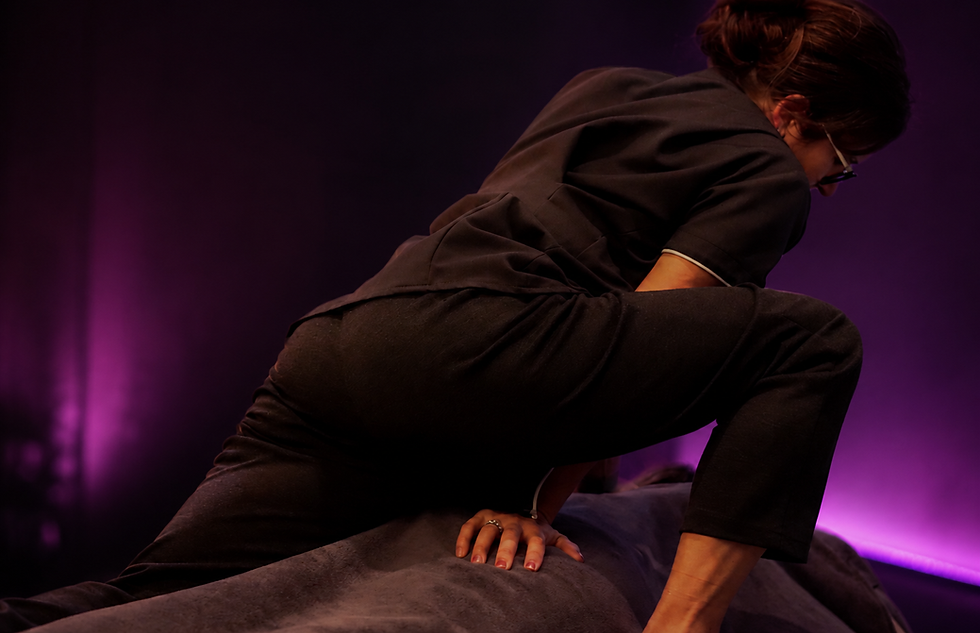
in the meantime, book a massage...
about therapyinc
Sam Clarke is an advanced facialist and Dermalogica Expert at therapyinc in Norwich, specialising in advanced facials, facial massage, microneedling, chemical peels, LED and personalised skin treatments for ageing skin, pigmentation, sensitivity and changing skin through menopause.


Comments